For clubs For athletes Guide Pricing About Contact Support
← User guide Part 2 · Athletes

For athletes

This part is for anyone who shoots, whether you belong to a club or train on your own. Independent athletes have all the same training tools; the few club-only screens are marked, and gathered at the end.

Your bottom tabs are Home, Log, Book, Club, and Stats. The Club tab holds the Scoreboard and your Competitions, with a switch at the top. Access profile, history, notifications, and settings from the header.

Your home dashboard

Home opens on what you are doing next, then on how you are doing. Before your first session it shows one thing to do and a short set-up list, instead of a dashboard of empty cards.

  • Up next leads the page: your next booked session with its lane, how long until it starts, and the program your coach set for it. Tap Start this session to open the log. With nothing booked, it is the Log a session button.
  • Your personal best shows match and final totals for each discipline, and when you shot it.
  • Your latest session includes its target plot, how the score sits against your usual, and where your coach's review stands.
  • Your week streak says what it needs to stay alive, beside your progress toward the next badge.
  • Your standing is three figures side by side: all time, this month and this year.
  • A competition you are invited to appears as a row with Respond on it. Your badges close the page.
Athlete home: the Up next card with the next booked session and its program, then the personal best, latest session, week streak and standing.
Home, for a club athlete.

Logging a session

Logging a session is built to be fast. A session has three phases: Setup, Session, and Debrief.

1 Open the Log tab

The Log tab opens on your next session: the setup you used last time, with today's booking and your coach's plan when there is one.

Below it are Log a past session, Competition simulation, your recent sessions with a link to the full history, and this month in one line.

Tap Start session to go straight to the keypad with that setup, or Change the setup first. The very first time, Start opens Setup.

Log tab landing screen: the next session card with Start session, tiles for Log a past session and Competition simulation, and recent sessions.
The Log tab.

2 Phase 1 · Setup, before you pick up the gun

Here you say what kind of session this is, on one screen. From here until you save, the tab bar steps aside and the bar at the top is the way around.

  • Session date defaults to today. Tap it to log a session you shot on another day.
  • Select Air pistol or air rifle.
  • Choose a session length. The keypad locks when you reach the limit.
  • To the tenth records every shot as the target reads it, and Whole rings takes one tap a shot, for air pistol. The scoring is fixed once shots are in.
  • Turn on Plot where each shot lands to record shot placement. It works in both kinds of scoring.
  • Games, pellets and cylinder is folded at the foot. Open it for Race to 100, Streak and Blank Target.
  • Pick what you are working on, as many things as apply: trigger release, follow-through, or a goal of your own.
  • My tags & goals sits at the foot of Setup, for writing a new one on the spot.
  • Pellet batch and cylinder pressure are in the same fold, each with a switch the app remembers.

Start session is pinned at the bottom, with your setup in one line under it.

Session setup on one screen: discipline, session length and scoring as tiles, goals, and Start session pinned at the bottom.
Phase 1, Setup.

3 Phase 2 · Session, on the line

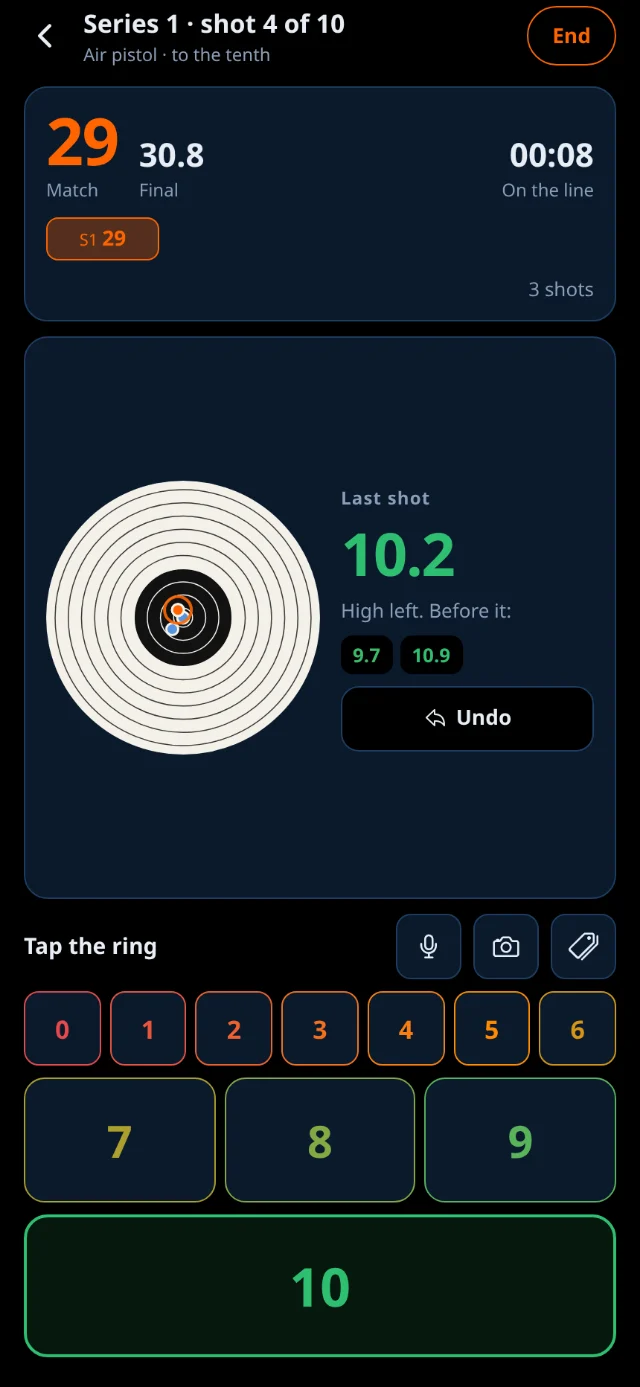
This is the screen you use between shots. The whole loop is on it at once, so nothing scrolls under your thumb.

  • Tap the ring, then the tenth. The keys are sized by how often you use them: 10 is the largest, 7 to 9 are large, and 0 to 6 are a row above.
  • The top summary shows your score, the series as a strip, and how far through the session you are.
  • Under it are your group on a live target, the last shot, the three before it, and Undo.
  • With plotting on, tap the side of the target the shot landed on. Technique ratings and one-tap tags are behind the tag button beside the microphone.
  • Tap the target to see the whole group and open the shots editor, where a shot can be replaced or removed.

Tap End at the top when finished.

The logging screen three shots into a session: the score and series strip, the live target with the last shot and Undo, and the keypad with 10 as its largest key.
Phase 2, three shots in.

4 Phase 3 · Debrief, gun cased

Now you reflect, and typing is welcome.

  • The result comes first: your score, a bar for every series, your group, and New personal best when it is one.
  • Rate hold, trigger, follow-through and stance, a line each, then effort from 1 to 10. Effort is RPE, Rate of Perceived Exertion; tap the ⓘ for the definition. The keys run green through red, so the direction of the scale is clear before you read the labels.
  • Select any drills you practiced.
  • Add free text notes.
  • Under What stood out, add or remove tags and read back the goals you set.

Tap Save session. Club athletes can first switch on Ask your coach to review this session. Discarding loses the session.

The debrief: the result with series bars and the group, one-line ratings, an effort scale, tags and notes.
Phase 3, Debrief.

Your own goals and tags

A score says how you shot. A goal says what you were trying to do, and a tag says what happened while you did it. Both are yours to write, and together they are what turns a column of numbers into training you can read back.

1 Set the goal before the first shot

Setup has a Session goals card carrying six built-in goals: trigger release, follow-through, body stance, breathing, sight alignment and mental. Tap as many as apply and the card header counts them.

What you picked is read back to you in the debrief, saved with the session, and travels into your data export and into any review you ask your coach for.

Naming the intention before you shoot is what makes a session answerable afterwards. The question stops being what did I score and becomes did I do what I came here to do.

2 Write your own

My tags & goals sits directly under the goal chips in Setup, and again on the Log tab for quiet upkeep between sessions. Open it, choose Goals, Faults or Successes, type the chip and tap Add.

  • Goal chips join the six built-ins in Setup, in the same row.
  • Fault and success chips join the one-tap chips you tap on the line, in Phase 2.
  • Tap the ✕ on a chip to delete it. Sessions you already saved keep the wording they were logged with.

Use the words your coach actually uses with you: wrist lock, grip pressure, first-shot nerves. A list you wrote yourself is a list you will really tap between series, and a chip beats a sentence you would have to type standing at the bench.

What they give you back

  • Your history reads as intent, not only as score. A session shot against a trigger release goal and tagged Snatched Trigger explains its own bad series months later.
  • Your coach sees them. Goals and chips come through on a session review, so the feedback lands on what you were working on rather than on the total alone.
  • They are in your export. Every session sheet carries its goals, in both the spreadsheet and the PDF report.
  • They earn you a badge. The Analyst wants ten sessions logged with the whole picture: pellet batch, hold and follow-through ratings, at least one goal and at least one tag.
One goal beats five A session with a single goal you actually held is worth more than one with every chip lit. Pick the thing you would change if you could only change one, and let the rest of the session be ordinary.
Mobile app only

Calling your shots out loud

Between shots your hands are on the grip and your eyes are downrange. Above the keypad there is a microphone: tap it and say the shot the way you read it off the target.

  1. Tap the microphone above the keypad.
  2. Say the ring, tenth, and placement. For example, 'eight five top right'.
  3. Listen for the tones. A short blip means a word registered; a different, rising pair means the shot was saved. You never have to break position to check that it worked.
  • Say 'center' for no particular placement, or 'scratch' to restart.
  • With target plotting off, the shot goes in as soon as you have said the score. In quick mode, one number is the whole shot.
  • The keypad is always available if needed.
  • Speech recognition listens in the app's language, which is English for now. Greek, German, Spanish, French and Italian are ready for when the app ships in them.
Your voice never leaves the phone Recognition runs on your device and uploads nothing. Some phones have no offline speech recognition of their own: on those, the first use downloads a speech model once (about 60 MB), and after that it works offline too.
Beta Mobile app only

Reading the scores off the target screen

On a range with electronic targets, the scores are already on a monitor a metre away. Photograph it at the end of a series and the shots go straight into your session, instead of being typed in twice.

1 It is already on

Scanning is part of Solo Premium and club membership, and is on by default. The switch is under Profile → Settings → Scan from a target screen if you would rather not be offered the camera.

Settings screen showing the Scan from a target screen panel, marked Beta, with a Read shots from a picture switch.
The switch, under Profile then Settings.

2 Photograph the panel

In a session, tap the camera beside the microphone, then Take a picture, or choose a picture you took earlier. Fill the frame with the whole screen, or with just the list of shots down its side, and get close enough that the scores are easy to read.

A session in progress, with Take a picture and Choose a picture opened under the scoring keypad.
Both ways in, opened from the camera button.

3 Check it, then add it

Check what it read, then tap to add the series. Nothing reaches your session until you confirm.

This example shows the check at work: the totals are six short, and the app has already worked out why. Shot 10 reads 3.8, and the numbers add up if it is 9.8. One tap accepts the correction.

The review sheet: a warning that the read total of 72.8 does not match the screen's 78.8, a suggestion that shot 10 reads 3.8 and should be 9.8 with a Use 9.8 button, and the ten shots listed with their directions.
Nothing is added until you confirm.
  • It checks its own reading. A SIUS panel prints a subtotal under every series. The app adds up what it read and compares. On a clear photograph the two agree, the verdict turns green, and one tap adds the series.
  • If anything is off, it says which shot. On the odd picture where the totals disagree, the size of the gap usually identifies the shot on its own, so you get 'shot 34 reads 3.4, the totals work if it is 9.4' with one tap to accept. It stays quiet rather than guessing when two shots are equally likely.
  • Tap any shot to retype it, or remove one that should not be there. The verdict updates as you go and turns green the moment the numbers add up.
  • The little arrows beside each score are what plot your shots, and they come through with the scores. If a picture is too soft to make them out, the scores still go in and the app tells you they are unplotted.
  • Only new shots are added. Shots already in your session are skipped and checked: if one reads differently from what you logged, the app names it before anything is added. Photographing the same screen twice is harmless.
  • Every make of screen is read the same way: SIUS, MEYTON, DISAG, MEGAlink, Haering, Kongsberg. The picture is read on our server, and only once you allow it. Whatever lands in your session is something the app genuinely recognised.
The picture is deleted once it is read Each picture is sent through our server to Anthropic, our AI provider, to be read, and only after you have said yes. It is not stored, it is never saved to your camera roll, and it is deleted from your phone as soon as it has been read.

Target plotting

Turn on target plotting in Setup to capture placement, not just score. Plotting is a property of the session rather than of how finely it is scored, so it works in quick whole-ring scoring exactly as it does in precise: the compass follows whichever key completes the shot.

  1. Enter the shot’s value on the keypad as usual.
  2. Tap the direction on the compass.

The session displays on a target plot with correct ISSF proportions.

Note The plot is honest about what it is: a reconstruction from a tapped direction, not electronic-target coordinates. It is more than enough to see your grouping and read your misses, which is what it is for.
The one mode that cannot plot Blank Target hides the target while you shoot, so there is nothing to plot on. It is the only mode that disables the switch, and it says why rather than leaving it on and quietly ignoring you.
A saved session’s page: the score, the group on the target, the series scores and the coach review.
A plotted session, reviewed afterward.

Game modes

Game modes ride the exact same logging screen, so there is nothing new to learn. They change only the goal and what the summary shows. In Setup they sit in the Games, pellets and cylinder fold at the foot, closed by default because most sessions are ordinary match scoring. Open it to pick one of the three, and the fold names your pick even when it is closed again.

  • Race to 100: shoot until you reach 100 in the fewest shots.
  • Streak: track your consecutive tens.
  • Blank Target: focus on form with the score hidden.

Practice history, and replaying a session

Open History from the Log tab to browse every session, a month to a card.

1 Read the rows

Each row shows the day, the event and its length, and the score.

A gold Best marks a personal best. The line under the event says how the session sat against your usual, and where its coach review stands.

Practice history as rows under their month, each with the day, the event, how it compared with the usual, and the score.
History, newest first.

2 Open one

Tap a row to open the session on a page of its own.

  • Overview shows your group, the series scores and your coach's review.
  • Shots has the per-series targets, the target plot and a numbered grid of every shot.
  • Your debrief ratings, tags and notes are on the overview too.
  • Edit shots and Share sit under the page. Request a review from the overview, and delete from the top.
  • Tap Insights to read the session's insights again.
A saved session’s page: the score, the group on the target, the series scores and the coach review.
One tap opens the session.

3 Watch it back

Tap Watch the session to replay your shots.

Use Play, Pause, or the scrubber to review your session's progression.

Generate a branded image to share your session.

Deleting a session Tap the bin at the top of a session to remove it permanently, after confirming.
The session replay on the Shots tab, showing the target with the group building up and playback controls.
The replay, mid-playback.

After every session: your insights

Save a session and a sheet opens with what it says about your shooting, compared with the sessions you shot before it. Every session in your history has an Insights tab that shows the same reading again.

1 Read it back

  • The headline: your score, a Personal best badge when it is one, and how the session compares with your usual level per series of ten.
  • The figures worth a glance: per series, tens and inner tens, your best series, and your shots below 7, the 6 ring or wider.
  • Coach's notes: the one thing to focus on next session first, then up to three more, each with what to do and the sample it rests on. A note appears only once there is enough shooting behind it.
  • Charts: your series against your usual, a rolling ten-shot average, your shots by ring, where the misses went, and your technique ratings.
A session’s Insights tab: the score against the usual level, and tiles for per series, tens, inner tens and shots below 7.
The session's insights.

2 Signs of trigger snatching

A shot that lands far outside your own group, on its own between good shots, is the mark a snatched trigger leaves. When a session shows it, a note says so, marked Possible or Likely, with a checklist of what it rests on:

  • Isolated wide shots, measured against your own spread rather than a fixed score, so a beginner and an international are each judged fairly.
  • Misses pulled low toward your trigger hand, on a pistol, read for the hand set in your profile.
  • Your own rating of your trigger control. It can strengthen a clue from the target, never raise a suspicion alone.

It is a suspicion, not a diagnosis, and the note says how to check it: dry-fire with a coin balanced on the barrel.

The focus card, Signs of trigger snatching, marked Likely, with a checklist of the wide shots, the pull and the trigger rating.
The focus for the next session, with its evidence.

Your statistics

The Stats tab reads everything you have logged and answers three questions in order: how you are shooting, what stands out, and what each measure says.

The page opens on one figure: your average per ten shots for the period, with the line of your sessions under it and what it rests on. Under that, What stands out lists the findings that most need your attention, most urgent first. Pick the period at the top: your latest session, your last five, or the past week, month, year or all time. Every figure follows it.

The Stats tab: the average series with its trend line and figures, and the findings that stand out under it.
One figure first, then what stands out.

Under that are the readings, a tile each. Tap one for the full chart, what it found and how the figure is worked out:

  • Practice and competition: your practice average beside your competition average, so you know before entry closes whether a gap is technique or nerves.
  • Through a session, and Start and finish: your average for each series with the weakest named, and each session's first 20 shots against its own last 20, to spot where a session starts to slip.
  • Shots below 7: how often a shot lands in the 6 ring or wider, beside the previous period, with the ring mix it sits in and a column for each session. Fewer is better, and it is compared with your own history, not with anyone else's.
  • Where shots land: your plotted shots on your own discipline's target, for the last 10 to 60 shots or the last few sessions.
  • Technique ratings: hold, follow through, trigger pull and stance as four bars, with your club's average marked on each. This uses the 1-to-5 ratings you give in the debrief.
  • Goals: each goal you set before your first shot, followed through the sessions that carried it. For trigger release, follow-through and body stance you see the matching rating move from your earlier sessions to your recent ones, and for every goal your score with it against your sessions without it.
  • Effort and score, Volume and Rest days: your hard sessions against their scores, your shots in each week, and your score by days of rest.

A reading that cannot say anything yet tells you how far off it is, for example 5 of 8 sessions, and does not show an empty chart.

The readings on the Stats tab: tiles for Through a session, Where shots land, Start and finish, Practice and competition, Shots below 7 and Technique ratings.
The readings, a tile each.

Shots below 7: how often a shot lands in the 6 ring or wider, beside the previous period, with the ring mix it sits in and a column for each session. Fewer is better, and it is compared with your own history, not with anyone else's.

The Shots below 7 reading, open: the share of wide shots, the ring mix as one bar and a column per session.
Shots below 7, with the ring mix and each session.

Goals: each goal you set before your first shot, followed through the sessions that carried it. For trigger release, follow-through and body stance you see the matching rating move from your earlier sessions to your recent ones, and for every goal your score with it against your sessions without it.

Each rating is drawn on the 1 to 5 scale you rated on: the hollow dot is where you started, the filled one where you are now. When a goal has no reading yet, it says why, for example that the rating was not given in the debrief.

The Goals reading, open: each goal with its sessions, the trigger rating rising on a 1 to 5 scale, and what was found about each goal.
Goals: what each goal has done.

The Insights tab is the whole report, the same read a coach gets, trigger-snatching check included, grouped into Needs work, Worth knowing and Strength. Each finding says what to do about it and leads to its chart. It is on unless you switch it off in Profile → Settings, and your copy says plainly that it does not replace a coach.

The Insights tab: a note that the report does not replace your coach, a finding open with a What to do line, and the strengths listed under it.
The Insights tab: every finding, most urgent first.

Competition simulation

A range officer in your pocket. It runs the official ISSF 10m sequence and calls every command out loud at exact match cadence, making match rhythm routine. It works wherever you can hang a target.

  1. Open the Log tab and tap Competition simulation.
  2. Choose Qualification for the full match, or Finals for the 24-shot final.
  3. Press start, put the phone down, and shoot. A large countdown, a live caption of the last command, and Pause / Resume / Stop are on screen, but the point is the voice.

Before you start and while it runs, you see the whole sequence as a step list, highlighting the current step and ticking off completed ones. Tap Skip to jump to the next step.

When the run ends, say whether you finished it, then add a rating, score and note if you like. The simulator keeps your finished runs and shows how they are going.

The competition simulation screen with mode selection and the full ISSF step list.
The simulator, before starting.

Achievements and the scoreboard

Achievements

Every badge is earned from something you actually did. Nothing is random and nothing can be bought. Each one is a small target with the mouflon at its top: a milestone climbs bronze, silver, gold and platinum, lighting another ring each time, and a locked badge keeps its shape and loses its colour.

  • Milestone badges for pellets fired, tens shot, competition wins and weekly practice streaks.
  • One-off badges for a perfect series, breaking a personal best, returning after a break, time of day and club anniversaries.
  • Practice-habit badges like Well-Rounded (drills from all four categories) and Iron Will (five sessions logged at maximum effort).
  • Precision badges for a single shot or a single session: Dead Center for a 10.9, Heartbreak for a 9.9, Clutch Finisher for a 10.5 or better on the very last shot, and The Machine for forty inner tens in one session.
  • Consistency badges for the shape of your training: Marathon Session, Weekend Warrior, Four Seasons, New Year’s Resolution, Gearhead, Coach’s Pet, Data Junkie, and The Analyst for ten fully detailed sessions.
  • Leaderboard medals in gold, silver and bronze for the top ranks, computed live.

Tap any badge, earned or locked, and a card tells you what it is and what it takes. A locked badge is a target, so nothing in the case is a mystery.

Every new badge drops a notification, and your progress toward the next one shows on Home.

Most Valuable Athlete One badge is not earned from a counter: Most Valuable Athlete is awarded by hand, and it stays out of your case entirely until it is yours.
The achievements screen: badges drawn as targets with the mouflon crest, with progress toward the next tier.
Your badge case.
Club athletes only

The scoreboard

The Scoreboard is the first half of your Club tab: your live club leaderboard. Filter by category to see top ranks with medals and your own highlighted row. It updates in real time.

Only precise sessions count toward it, so your scoring mode in Setup matters.

The Club tab on the scoreboard, with the switch to Competitions at the top, category filters and ranked athletes.
The club board.

Booking lane time

The Book tab manages your upcoming training calendar, varying whether you shoot at a club or on your own.

Upcoming sessions come first. Sessions that have ended fold away under Past sessions: open it for the latest five, then show five more at a time.

Club athletes only

Booking a club lane

  1. The Book tab opens on your next session: the day and the hour, whether it is confirmed, and what your coach set for it.
  2. Under Book a lane, pick a day from the strip. The hours are one-hour slots in your club's timezone, and a slot says Last lane or Full when that is so.
  3. Tap an hour, choose your own gun or a club gun, leave a note for the coach if you like, and tap Send request. The lane is held for you at once, and a coach confirms it.

Swaps: Request a swap to trade a slot with a teammate on the same day. If accepted, your bookings exchange while keeping lane assignments, saving the swap in your history.

Training your coach set you If your coach attached a training program, it is on the session's card with their note. Open the session to tick off the drills they set, or tag the same drill in a session debrief to complete it automatically.
The Book tab: the next session’s card with its plan and a Start session button, the other bookings under it, and a strip of days to pick from.
Your next session, your other bookings, and the days you can book.
Independent athletes

Scheduling your own training

Without a club, the Book tab acts as a personal calendar built on your own training grounds, such as a commercial range, visiting club, or home setup.

  1. Add your training grounds from Profile → Training grounds.
  2. In Book, choose where, pick a day, and set from and until.
  3. Your slot is scheduled instantly. There is nobody to approve it.
  4. Use Repeat weekly to schedule the same session every week for a month, three months or a year. The form says how many sessions that makes before you schedule them.

This is what lets you plan a training calendar, attach programs and drills to specific days, and get booking reminders without belonging to a club.

The training grounds screen where an independent athlete adds the ranges they use.
Training grounds.

With at least one training ground saved, the Book tab becomes your own calendar: your next session first, then the form for scheduling another. A session that repeats is shown once, and you can cancel one date or all that are left. Booking reminders work the same way as for a club booking.

An independent athlete’s Book tab: the next session of a weekly series, another session under it, and the form for scheduling one.
Scheduling a solo session.
Club athletes only

Competitions and coach reviews

Competitions

  1. When staff enter you into a club competition, you receive an invitation in your notifications, on Home, and under Competitions on the Club tab.
  2. Accept or decline it.
  3. On the day, your relay, lane and start time are on the entry, along with the club gun you have been allocated if you are not shooting your own.

Competitions keeps your history, including your finishing place, and shows the live scoreboard for each event.

You can only be entered if staff marked you as competition eligible. If you expected an invitation but did not receive one, ask your coach.

The Club tab on Competitions, showing invitations and past results.
Invitations and history.

Asking your coach to review a session

Want your coach’s eyes on one particular session?

  1. Open the session in your practice history.
  2. Tap Request a review.

Your coach is notified, reads that exact session (its plot, shots and notes), and replies with written feedback tied directly to the shots you fired. You get a notification when the review lands.

Your profile, equipment and fees

Tap your avatar in the header to access your profile settings.

Your profile holds Details, Equipment and Settings, with Fees for a club athlete, or Training grounds and Premium when you train on your own.

The profile hub with links to details, equipment, analytics and settings.
The profile hub.

Details

Your name, date of birth, phone, photo, ISSF ID and shooting-club ID.

  • Your club ID receives a verification mark once the club confirms it. Changing the ID removes the mark until it is re-verified.
  • If you are under 18, guardian fields appear so the club can contact a responsible adult.
Consent, and consent for juniors When required, you must agree to the privacy notice. For athletes below the age of digital consent in their club's country, a parent or guardian must agree on their behalf. A panel appears under the guardian details where parents confirm on the device or staff record it from a signed form. The guardian's name and email must be saved first.
Profile details with name, date of birth, phone and ID fields.
Editing your details.

Equipment

Your own guns and pellets, kept separately from the club's armoury.

  • Add a gun from the catalog of known 10m air guns, or enter a custom one, tracked by serial number.
  • The manufacturer field is a searchable list. If your brand is missing, you can add it to your private list.
  • Guns carry cylinder compliance: the stamped 10-year expiry, a warning as it approaches, and a service flag.
  • Replacing a gun retires the old one cleanly and keeps it for history rather than deleting it.

Your active gun is what appears on your share cards, and what staff see when allocating equipment for a competition.

The equipment screen listing the athlete's own guns and pellets.
Your own equipment.
Club athletes only

Fees

If your club charges membership fees, the Fees screen shows your balance and individual fees.

  • Pay online securely by card through your club's payment account. Card details never reach Mouflon.
  • Or pay cash at the counter and your club records it. Both settle into the same ledger, so the balance you see is always the real one.
The fees screen showing an outstanding balance and individual fees.
What you owe the club.
Independent athletes

The independent athlete

Everything above is yours whether or not you belong to a club. This is the short version of what changes when you train on your own.

What you get, and what is simply not there

  • The whole training app is yours: logging, calling your shots out loud, target plotting, game modes, your own goals and tags, history and replay, insights after every session, statistics and coaching insights, the competition simulator, share cards and achievements.
  • Book becomes your own calendar, built on the training grounds you add in Profile → Training grounds. There is nobody to approve a slot, and programs, drills and reminders work exactly as they do on a club booking.
  • The club-only screens are absent rather than locked: no club scoreboard, no club competitions, no fees, no coach reviews.
  • Your public portfolio is the way you show your training outward, to Instagram or to a sponsor, without a club board behind you.

After 30 days, your account moves to the free tier unless you subscribe to solo premium. Logging itself is always free, so your sessions, streaks and badge counters keep accruing either way.

Joining a club later Your history goes with you. Join a club and every session you have logged comes along; leave one and it stays yours. Nothing you record on your own is trapped in a decision you made at sign-up.
The solo premium screen explaining what the subscription adds.
Solo premium, and what it adds.

Settings

Found in Settings.

The rest of the screen

  • Notifications: toggle push notifications, booking reminders, and mute by category.
  • Mute by category: Bookings, Coaching, Competitions and Achievements can be silenced independently. Muting a category stops push notifications while keeping items in your in-app bell.
  • Public portfolio: your shareable link, and a switch per section deciding what it shows.
  • A published page carries your personal best in both ISSF totals, the target plot of the session that set it, your badges drawn as the badges, and whatever else you switch on. Anything switched off is never sent to the page rather than hidden on it.
  • Password, data export and account deletion.
Athlete settings with each section collapsed.
Settings, closed. One tap opens what you came for.

Appearance

  • Twelve themes: Mouflon Dark, Mouflon Light, Mouflon OLED, Purple Summer, Purple Winter, Blue Lagoon Winter, Olive Grove, Terra Waterfalls, Pastel Sky, Tropical, Coral Bay and Sapphire Gold.
  • System theme follows your device settings between Light and Dark mode.
  • If you never choose, the training area stays on Mouflon OLED, the true-black theme. A chosen theme applies everywhere.
The theme picker open, each palette shown as a swatch in its own colors.
Twelve themes, each shown in its own colors.

Offer code

  • Type your code and tap Redeem. Premium access activates immediately, showing the expiration date.
  • Codes are not case-sensitive.
  • Redemption history lists your receipts.
The offer code panel open, with a field to redeem a code.
Redeem a code, and read back everything you have redeemed.

Exporting your data, and deleting your account

Export

Export your entire account as a spreadsheet or PDF report, including your profile, sessions, equipment, badges, bookings, notifications, coach reviews, competition entries, fees, programs, and settings.

Data is generated on your device. You can also export a single session from its share screen.

Delete

Also from Settings, you can delete your account yourself. It is a deliberate three-step flow: open it, type your email to arm it, then confirm. Everything of yours is then erased.

If you own a club A club owner must close or hand over the club first.